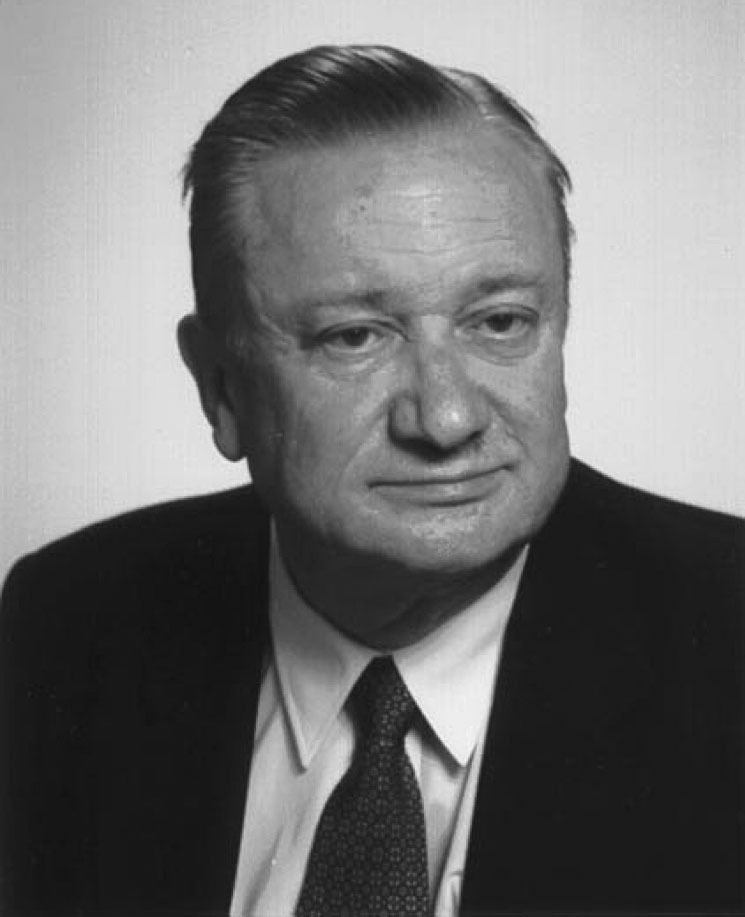
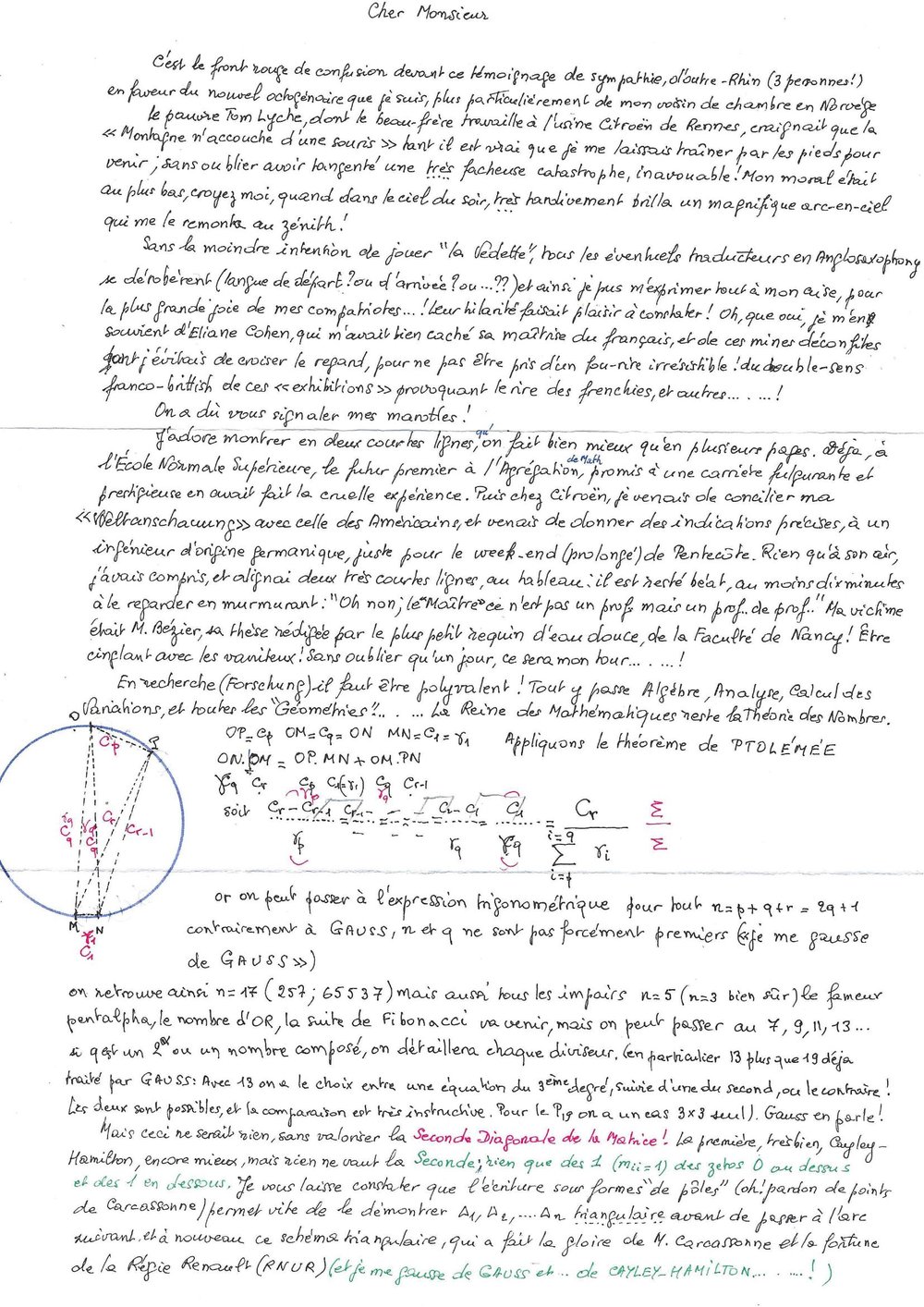
de Faget de Casteljau, P. (2001). Fantastique strophoïde rectangle. Revue internationale de CFAO et d’informatique graphique 16, 357–370.
What’s in this document?
This article makes a bold claim: after the circle, the right strophoid – not any conic – is the true second fundamental curve of metric geometry. Generated by a point on a line rotating at a fixed 1:2 angular ratio relative to a second, pivoting line (the roue de vélo, or bicycle-wheel, construction), the curve turns out to be anallagmatic: invariant under inversion in an appropriate circle. That combination – simple angular generation plus self-inversion – connects it to an ‘incredible family’ of sixteen circles, extending the classical Feuerbach and Hart circle theorems into territory no conic reaches. De Casteljau himself worked this out for the strophoid, the degree-3 case (n=3); pushing the same circle-secant argument one degree further, to the quartic case (n=4), turns out to be just as fruitful, suggesting the pattern continues for n>3 as well.
de Faget de Casteljau, P. (2001). Au-delà du Nombre d’Or. Revue internationale de CFAO et d’informatique graphique 16, 19–31.
What’s in this document?
A short article extending the golden ratio’s role in the pentagon to a general theory of diagonal ratios in regular (2n+1)-gons, derived by treating Ptolemy’s theorem as a polar form of Pythagoras. For the pentagon (n=5), the golden ratio itself falls out as d₅/u₅ − u₅/d₅ = 1. For the regular 11-gon (n=11), de Casteljau builds two companion constructions: “l’Ange,” a 5×5 matrix M encoding the chord relations, and “l’Archange,” a Fibonacci-style recursion linking M to its inverse. As the matrix power M∞ is taken, its integer entries converge not to a single ratio but to the squared chord lengths u², d², t², q², c² and their Ptolemy-linked differences — a direct five-variable generalisation of the classical Fibonacci matrix for the golden ratio, tied to a degree-five characteristic equation and a five-variable extension of the Euclidean algorithm.
de Faget de Casteljau, P. (2000). Intersections et Convergence. In: Laurent, P.; Sablonnière, P.; Schumaker, L.L. (eds.): Curve and Surface Design: Saint-Malo 99. Vanderbilt University Press, 9–15.
What’s in this document?
Despite the near-identical title, this tackles a different problem from the 1998 paper: finding roots of a general polynomial by approximating it near zero with a rational function, via a cascading sequence of ever more refined continued-fraction corrections. The method gains roughly one decimal digit of accuracy per iteration computing eˣ, sin(x), and ln(x). Extended to three variables, it produces what de Casteljau himself calls a miracle: however the resulting indeterminacy is resolved, the same numerator always appears – an empirical uniqueness he records without fully explaining it. His own framing of the whole exercise: ‘an industrial approach, not a university one’ – the goal was one correct root, not elegance.
de Faget de Casteljau, P. (1999). In mémoriam Henri de Faget de Casteljau: Son autre passe-temps, la géométrie à travers l’hexagone de Pascal. Procès-verbaux et Mémoires de l’Académie des Sciences, Belles Lettres et Arts de Besançon et de Franche-Comté 193, 91–114.
What’s in this document?
Written to commemorate his brother, this memorial text doubles as the most concentrated statement of de Casteljau’s geometric philosophy. ‘It would be absurd,’ he writes, ‘to think that Geometry is wholly contained in Algebra’ – analytic geometry, in his view, has a congenital defect: it loses the local, differential character of geometric objects by embedding them wholesale in algebra. His guiding principle, the gomme (eraser): a figure’s essential content is exactly what can be neither removed nor added to without ‘deflowering’ it. He illustrates this with a single master figure of fewer than twenty lines and three conics from which six or seven classical projective theorems – Desargues, Pascal, Brianchon, Steiner, Poncelet, Kirkman – can all be read off by highlighting different subsets. Behind that figure lies a deeper find Henri never named as such: his ’15 synthèmes’ and ‘6 totals’ independently reconstruct, by pure hexagon geometry alone, the exceptional outer automorphism of S6 – the same structure Sylvester encoded combinatorially in 1844 and Schläfli found geometrically in the 27 lines of a cubic surface. And, almost in passing, a claim that his lattice-and-quaternion studies lead ‘gently, as if playing’ to a formal derivation of the Lorentz equations.
de Faget de Casteljau, P. (1999). De Casteljau’s autobiography: My time at Citroën. Computer Aided Geometric Design 16, 583–586. Translation based on Müller and Schultze (1995). https://doi.org/10.1016/S0167-8396(99)00024-2
de Casteljau, P. (1998). Intersection methods of convergence. In: Farin, G.; Bieri, H.; Brunnett, G.; de Rose, T. (eds.): Geometric Modelling. Springer, Vienna, 77–80.
What’s in this document?
How do you find where two conics meet, fast, on 1960s hardware? De Casteljau’s answer: the point Ω, an iterative construction built from cross products of conjugate points that converges to fourth order – reducing a computation that took 15–20 minutes on Citroën’s Bull M60 computer to under five. He’s equally candid about where the method broke: an attempt to generalise from two conics to three variables – planar to spatial – simply failed, a rare instance of a mathematician documenting his own dead end in print.
de Faget de Casteljau, P. (1997). La Tolérance d’Usinage chez Citroën dans les Années (19)60. In: le Méhauté, A.; Schumaker, L.L.; Rabut, C. (eds.): Curves and Surfaces with Applications in CAGD. Vanderbilt University Press, 69–76.
What’s in this document?
Three decades after the fact, de Casteljau looks back and unifies his own 1960s tolerance work into a single closed-form deviation formula – and adds a technique never published before: bicontact milling, using a torus-shaped cutter positioned to touch a surface at two points simultaneously, cancelling the ridge lines that ordinarily form between adjacent milling passes without any extra tool pass. A shop-floor invention, retrospectively formalised, that still has no acknowledged counterpart in the standard CAM literature.
de Faget de Casteljau, P. (1995). Courbes et Profils Esthétiques contre Fonctions Orthogonales (Histoire Vécue). In: Dæhlen, M.; Lyche, T.; Schumaker, L.L. (eds.): Mathematical Methods for Curves and Surfaces. Vanderbilt University Press, 73–82.
What’s in this document?
A direct polemic against using Fourier and orthogonal-function methods for smoothing mechanical cam and valve profiles. De Casteljau’s argument is physical, not merely numerical: fitting by matching two integrals silently performs a hidden differentiation, and differentiation amplifies exactly the high-frequency oscillations a smoothing method is supposed to remove. His alternative – building the curve directly from poles – achieves continuity of the first n derivatives by construction and lets the engineer eliminate precisely the harmonics capable of exciting mechanical resonance. The payoff wasn’t theoretical: Citroën’s loi 15 engine cam profile, redesigned this way, delivered a measurable gain in both power and RPM on the road.
de Faget de Casteljau, P. (1994). Splines Focales. In: Laurent, P.; le Méhauté, A.; Schumaker, L. (eds.): Curves and Surfaces in Computer Aided Geometric Design II. AK Peters, 91–103.
What’s in this document?
The paper’s own abstract stakes out a blunt position: algebraic degree, de Casteljau argues, is a poor fit for the shapes of nature – a simple screw thread traces a circular helix that is not remotely algebraic. Working in the older, Apollonian language of distances and angles rather than the projective apparatus of modern CAGD, he builds conics from three mutually tangent circles, then turns to optics: the paper’s centrepiece is the problem of conjugate aplanetic mirrors, solved via a single curve he calls the intermediate caustic – the envelope of the mean radius linking a point to its focal image. He closes by admitting the paper is really an outline for ‘a more complete book’ on metric geometry he still hoped, in 1994, to write.
de Casteljau, P. (1993). Polar forms for curve and surface modeling as used at Citroën. In: Piegl, L. (ed.): Fundamental Developments of Computer-Aided Geometric Modeling. Academic Press, 1–12.
What’s in this document?
De Casteljau’s most polemical English-language statement of the pole doctrine: geometry, he insists, must be built from pure algebra alone, and he dismisses quadratic minimization and orthogonal-function smoothing outright as illusory theories prone to hidden instability — the same target he attacks at greater length in the 1995 Fourier polemic. Poles here split into two kinds: “simple poles,” the now-familiar control points, and generalised poles built from a difference table longer than Newton’s, whose extra rows expose sub-poles and let continuity be checked and coefficients computed directly, via a pair of operators, Δ and δ, that turn one polar form of degree n into two of degree n−1. Along the way, a curious analytic aside: an expansion for cos φ/|cos φ| that he claims is the unique series converging correctly through φ = 0, offered as a cure for the Gibbs phenomenon. The historical asides are familiar but sharpened for an English readership — the initial verdict that modeling a car body mathematically was “nonsense,” the Citroën GS hood and the 1962 flying-saucer prototype as proof of concept, and the in-house SPAC-CAR system as the eventual industrial payoff. A footnote by the editor flags that his vocabulary departs from the Faux–Pratt textbook standard the field had by then settled on — a small but telling sign of how isolated de Casteljau’s terminology had remained even a decade later.
de Faget de Casteljau, P. (1992). POLynomials, POLar Forms, and InterPOLation. In: Lyche, T.; Schumaker, L.L. (eds.): Mathematical Methods in Computer Aided Geometric Design II. Academic Press Professional, 57–68. Translated by Hans–Peter Seidel.
What’s in this document?
De Casteljau’s first public, English-language account of the polar-form (blossoming) framework he had been developing internally at Citroën since 1959. The pole of n vectors is defined via elementary symmetric functions; setting all parameters equal recovers the ordinary Bernstein-form curve as a diagonal special case – the polar form is presented explicitly as the general multivariate object, the everyday curve as its shadow. Along the way: knot insertion explained as repeated parameter insertion, and a named ‘degree of reproduction’ as a design parameter distinct from both polynomial degree and continuity order – a classification competing quasi-interpolation methods of the period silently ignored, at the cost of avoidable error. He also cites Citroën’s 1962 flying-saucer prototype as manufacturing precedent, asserting industrial priority years ahead of any equivalent commercial CAD technique.
de Faget de Casteljau, P.; Friedel, J. (1956). Étude de la résistivité et du pouvoir thermoélectrique des impuretés dissoutes dans les métaux nobles. J. Phys. Radium 17, 27–32.
What’s in this document?
Long before Citroën, de Casteljau’s only publication was solid-state physics – co-authored with Jacques Friedel, one of the century’s most influential condensed-matter theorists (namesake of the Friedel oscillation and the Friedel sum rule). The paper models how a free-electron gas scatters off a spherical potential well of varying depth, using it to explain the electrical resistivity and thermoelectric power of polyvalent and transition-metal impurities dissolved in noble metals – the same quantum resonances (bound 2p, 3d levels) that underlie much of later dilute-alloy theory. Two years before he walked into Citroën not knowing a chassis from a crankshaft, de Casteljau was doing frontier quantum physics.